THE ISLANDERS
A Look of Love for Caribbean Foods

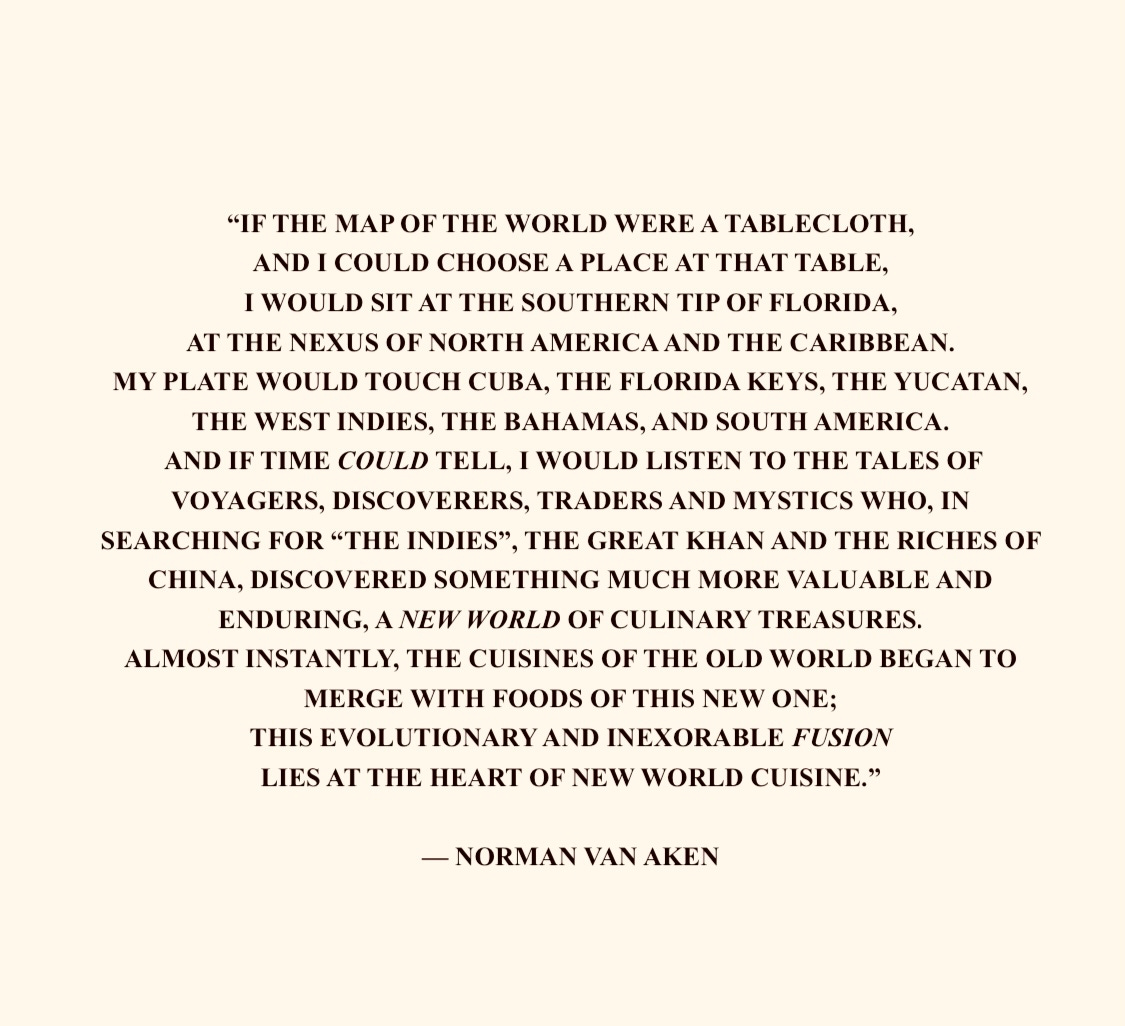
There is a long and important history of the Caribbean prior to the arrival of Columbus but the sparks of New World Cuisine positively ignited once the wayward Admiral accidentally bumped into the New World somewhere, (the location remains in some dispute) in the Bahamas.
From the log kept by Bartolome de las Casas in the 1530s. Las Casas was an historian and Columbus’s biographer who had access to the original journal of the voyage.
“Shortly after landing, many of the island’s inhabitants assembled on the beach and Columbus gave them gifts of red hats and beads. The natives reciprocated with gifts of parrots, cotton and other goods. In describing the natives, Columbus wrote: “They go as naked as when their mothers bore them, and so do the women, although I did not see more than one girl. They are very well made, with very handsome bodies, and very good countenances.”
Indeed, like many, Columbus fell in love with the place writing in a letter to the King,
“The banks of the rivers are embellished with lofty palm trees, whose shade gives a delicious freshness to the air, and the birds and the flowers are uncommon and beautiful. I was so delighted with the scene, that I had almost come to the resolution of staying here for the remainder of my days; for believe me, Sire, these countries far surpass all the rest of the world in beauty”.
The world at large can rightly give thanks to the Caribbean for some of the most indelible and time honored foods of all time; barbecue. (More on that in a bit). They also had a great deal to do with popularizing chile peppers, tomatoes and potatoes to a world that were largely unfamiliar with them prior to the years of trade within the 7,000 islands comprising over 2,500 miles of sea and land.
Six basic groups of Amerindians were living in these Islands before the Spanish arrived. The Arawaks, Tainos and Carib were among them. New World Cuisine was surely affected by the Pre-Columbian residents as New World Cuisine always finds the roots of a more ancestral times despite the evolutions of time.
The tropical tubers such as yuca, (also known as cassava) malanga, taro were prized by them. Corn and beans were grown and prospered there. Chile peppers were well loved and consumed in great amounts. The exotic fruits of the Caribbean such as guanabana were beloved by the natives too. The biodiversity of the Islands offered vast varieties of foodstuffs either unknown to the Europeans or to be had in more perfect forms in the new lands.
The Caribbean is so hard to pin down. It is, to paraphrase poet Walt Whitman, “a multitude!” Look down on a map of the Caribbean. It seems to have been a vast explosion millennia ago of land and sea. The biggest chunks of land include Cuba, the hyphenated island containing Haiti and the Dominican Republic, Puerto Rico and Jamaica. After that there are tiny places though resonating with a distinct food culture each onto themselves fiercely and unique in particular ways. Often due to the stamp of human history that marched across them as the New World seekers crossed over from the Old Word to this new one inflicting change as much as hoping for it. Even the casual traveler can note the differences of the cuisine of a place like Haiti and Puerto Rico.
It would be a mistake to assign “The Caribbean” to a simplistic set of flavors. Though many ingredients were common to the area their histories varied a great deal and with slavery as a constant the world of Africa was always the “Mother Ship”.
“One of the most interesting historical observations is that the slaves held dominion by the French almost always produced a more vibrant cuisine than those under the control of the English or Dutch. The theory promulgated is that the slaves the French ruled were not stripped of their drums and that made a huge difference to the spirit and power and love they had to pour into their cooking”. ---Raymond Sokolov, “Why We Eat the Way We Eat”.
In Key West, where I started my understanding of this cuisine, the influence that dominated were Cuban and Bahamian. Everything else came after that. As amazing as the cooking of Haiti, Jamaica, Trinidad and Puerto Rico is I admit that I came to learn of them more slowly as my interests in all things Caribbean expanded. And so my love for and responses to the area grew and flourished as I continued to evolve as a chef. As I look back on my first cookbook, “A Feast of Sunlight” and compare it to my third, “New World Kitchen” I can track the evolution of my understanding and appreciation for the eternally unveiling wonder of cultural immersions.
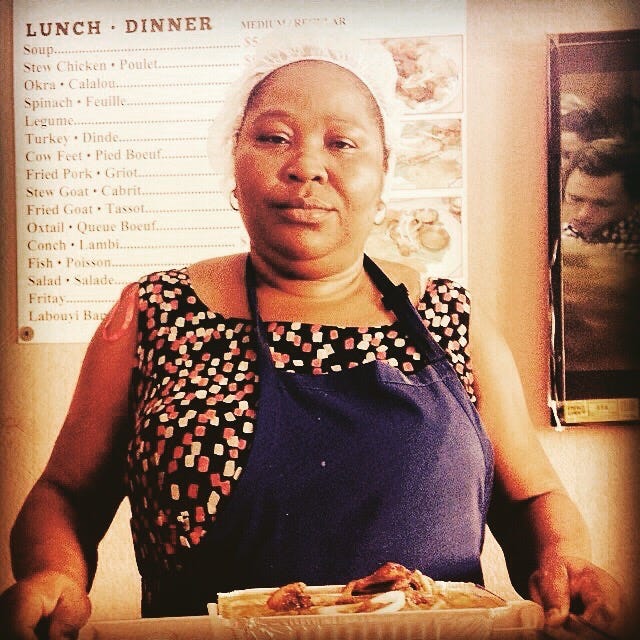
In the next paragraphs we will go over some of the major chords of New World Cuisine knowing that we could spend a solid year exploring the nuances of all things Caribbean!
Before getting underway I want to pass along my gratitude to a fine teacher.
When I began my more formal research on Caribbean cooking I was a bit stumped for books on the subject. Unlike the French and Italian cooking that dominated the restaurants and the book shelves I had to hunt for books to augment my growing understanding I got from simply living and cooking in Key West. One of the “god send” books I did discover back then was a paperback copy of “The Complete Book of Caribbean Cooking” by Elizabeth Lambert Ortiz. It was groundbreaking for me! And one of the significant prizes I got out of it was a freedom of language! I was captivated by the playful sounds of so many dishes that it made me happy to get cooking! ‘Féroce d’Avocat’...which translated as ‘a fierceness of avocados’ fired me up to find out what was in that! ‘Lambi Souse’ was so melodious it made me want to know. ‘Mofongo’ sounded like a Disney character. ‘Poisson on Blaff’ made me want to laugh. And so on. I was creating menus an with each passing years I became more emboldened to interpolate my formerly North American meets French with the sounds and flavors of the Caribbean dishes I was learning in her masterwork as well as my continuing street education.
CUBA
There is a ‘Cuban way” with flavor that is like describing beauty… fleeting. It is a way of catching the lyrics to an old song...but not quite being able to translate them. It is beautiful. Cubans remind me of Italians in the way they describe how to cook. They scoff at exact measurements. “You must go by feel!” And it is so true. So you must relax and in time the sabor will get you! The foods are seasoned with sofrito most often. It is a combination of tomatoes, garlic, cumin, herbs and olive oil. Lime is used very often to lift the food in a brilliantly simple way. Rice and Beans are a tradition bordering on a religion. When beans and rice are cooked together they are sometime called “Moros y Cristianos”. It refers to the dark skinned moors, (black beans) and the light skinned Christians, (rice). Mojo is another defining flavor of Cuban cookery. It is made with the juice of sour oranges, (naranja agria), olive oil, garlic, chilies and oftentimes, cumin. It is used as a marinade as well as a sauce. The sour oranges give it a distinct characteristic that I have come to love and utilize in my cooking very often. The are many foods prized in a Cuban kitchen. Cuban food is greatly influenced by Indigenous, African, Portuguese, Chinese, Arabic and different Spanish regions. The Creole traditions of them would fill pages. Fruit drinks called batidos are superior. The fish are second to none and the pork dishes revelatory!
THE BAHAMAS
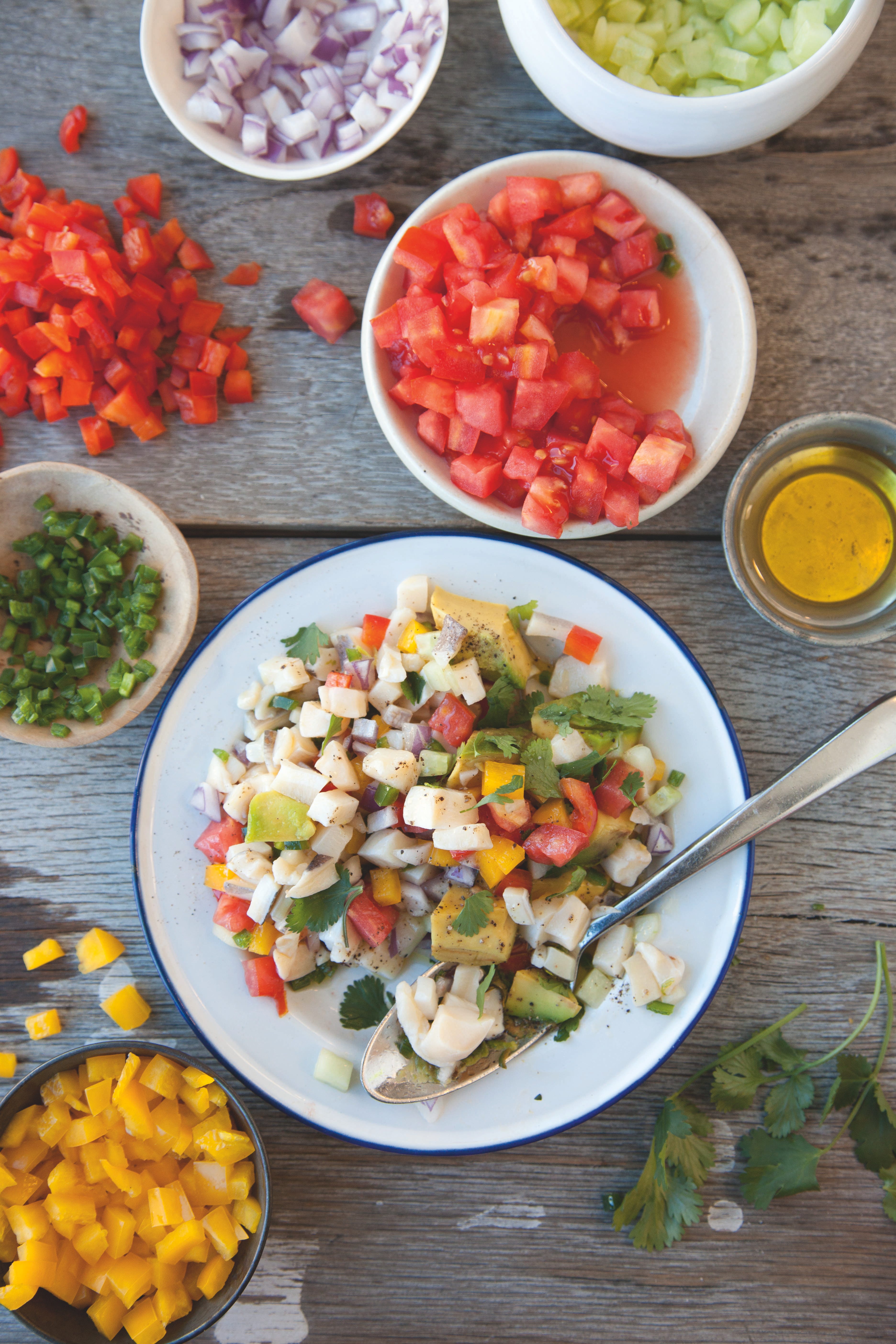
(Conch Salad from “My Key West Kitchen” by Norman and Justin Van Aken. Photo credit Penny De Los Santos)
Columbus set foot on solid ground for the first time since leaving Spain in the Bahamas. It was a portentous arrival to say the least. The Indians who’d lived peacefully there for 700 years were descendants of the Arawaks who had come up from South America over time. Columbus described them as ‘so full of love and without greed that I believe there is no better race’. Columbus had thought he’d landed on ‘the northern islands off Japan’. They sadly became a victim of the lust for gold over time.
The history of the Bahamas includes pirates, wreckers and smugglers. They shared this with Key West in fact. The people there are live in one of the most perfect weather zones in the world.
The name Bahamas derives from the Spanish baja (”shallow”) and mar (”sea”). It is the sea that dominates the cuisine. The cuisine is noted for vibrant seasoning and it is said that the food is never ‘bland at a Bahamian table’.
Grouper is prized and eaten in dishes such as ‘smudder grouper’ and ‘mango grouper’.
Conch is a shellfish or mollusk that is a staple of The Bahamas and Bahamian cooking. I first tasted it in 1971 in a conch ‘salad’ in Key West. It is like a giant clam but better in my opinion. The Bahamians make them into fritters, soups, stews and more. Pigeon Peas are served with Rice in most major meals. The American south’s love of grits has taken hold in the Bahama too.
Guava Duff is the most common dessert but coconut figures in many of them.
HAITI
Manje Kreyòl or Haitian food is like saying “Criollo” in many other countries. We might find the equivalent in the U.S. as “Soul Cooking”. One distinction in the cuisine of Haiti more than most other islands of the Caribbean is the more vigorous application of chilies. The primary influences are French, African and derivations of Taíno Indian and Spain.
Many would argue that not one country in the Caribbean has had a rougher time in history than Haiti. Dictators have been more constant than sunlight in what should and could have been a paradise. Race wars were and continue to be a cancer in Haiti. Today Haiti continues to struggle and though man won’t heal nature takes over to bring more heartbreak. The earthquake of several years ago is still a huge problem. Somehow through it all the Haitian spirit rises up and continues to share her great flavors.
Iconic Dishes of Haiti include:
Soupe Joumou: Traditional soup served on New Year’s Day as a tribute to Haitian independence whereby this soup is consumed when it was once forbidden by their French masters.
Griots: This word also means a “West African storyteller, praise singer and/or musician”. (Sounds like a modern rapper) but in food it refers to a stew of glazed pork.
Sauce Ti-Malice: This hot sauce is often served with fried goat or fried pork. It includes olive oil, garlic, bell peppers, tomato paste, apple cider vinegar, chili powder and lemon juice.
Riz Djon Djon: Essentially a Rice Pilaf with the unique flavor of the Haitian black variety of mushrooms named Djon Djon.
Poulet Roti: Roast Chicken done in the Haitian way. Flavors and ingredients include djon djon mushrooms, (Haitian black mushrooms), garlic, lime zest, lime juice, chilies, rum, chicken stock and bananas.
Coquimol: A coconut dessert sauce made with egg yolks, cinnamon, rum, vanilla and coconut milk. Often served over cakes instead of simple whipped cream.
PUERTO RICO
Puerto Rico, (Rich Port) is the most easterly of the four major islands that form the Greater Antilles. The Atlantic surrounds it on the north and the Caribbean Sea on the south. Columbus ‘discovered’ it on his second voyage in 1493. The natives called it “Borinquen”. The Spanish called it San Juan for St. John the Baptist. Eventually it took on the current name. Following the “Spanish-American” War of 1898 Spain ceded it to the United States and Puerto Ricans became citizens, wanted or not, in 1917.
As with many other islands of the Caribbean it was the immigrant parade of history that affected them in seismic ways. None was more important or affecting than the African one which was fomented through slavery. Some of the foods that were introduced to Puerto Rico during that span of brutal history included pigeon peas, plantains, yams and okra. The African cooks also developed many coconut dishes which remain popular. In terms of technique the most prized African way in Puerto Rico was frying in which they were expert.
Other historic legacies were introduced by the Dutch; edam cheese… the Italians; macaroni… and the Chinese; dumplings.
As time moved on North America became an influence as well reversing the West to East pattern of influence somewhat. With Puerto Rico’s inclusion as a property of the U.S. ideas and foodstuffs traveled freely. The very large Puerto Rican population that developed in New York City and other parts of the Northeastern United States fostered a culinary dialog that ignited many ‘fusions’ that inspired me as a cook too. I had mofongo in a restaurant in the 1980’s and by 1991 I was doing a version replacing the pork cracklings, (chicharrones) I had enjoyed … but with diced foie gras in my version. I placed it in the mash of caramelized plantains as a stuffing for chicken and served it on an intense black bean creation to much acclaim. As I type these words I am happy to add I’ll be teaching this preparation along with our son Justin at “The Key West Cooking Show” in an historic building (1856!) this very evening.
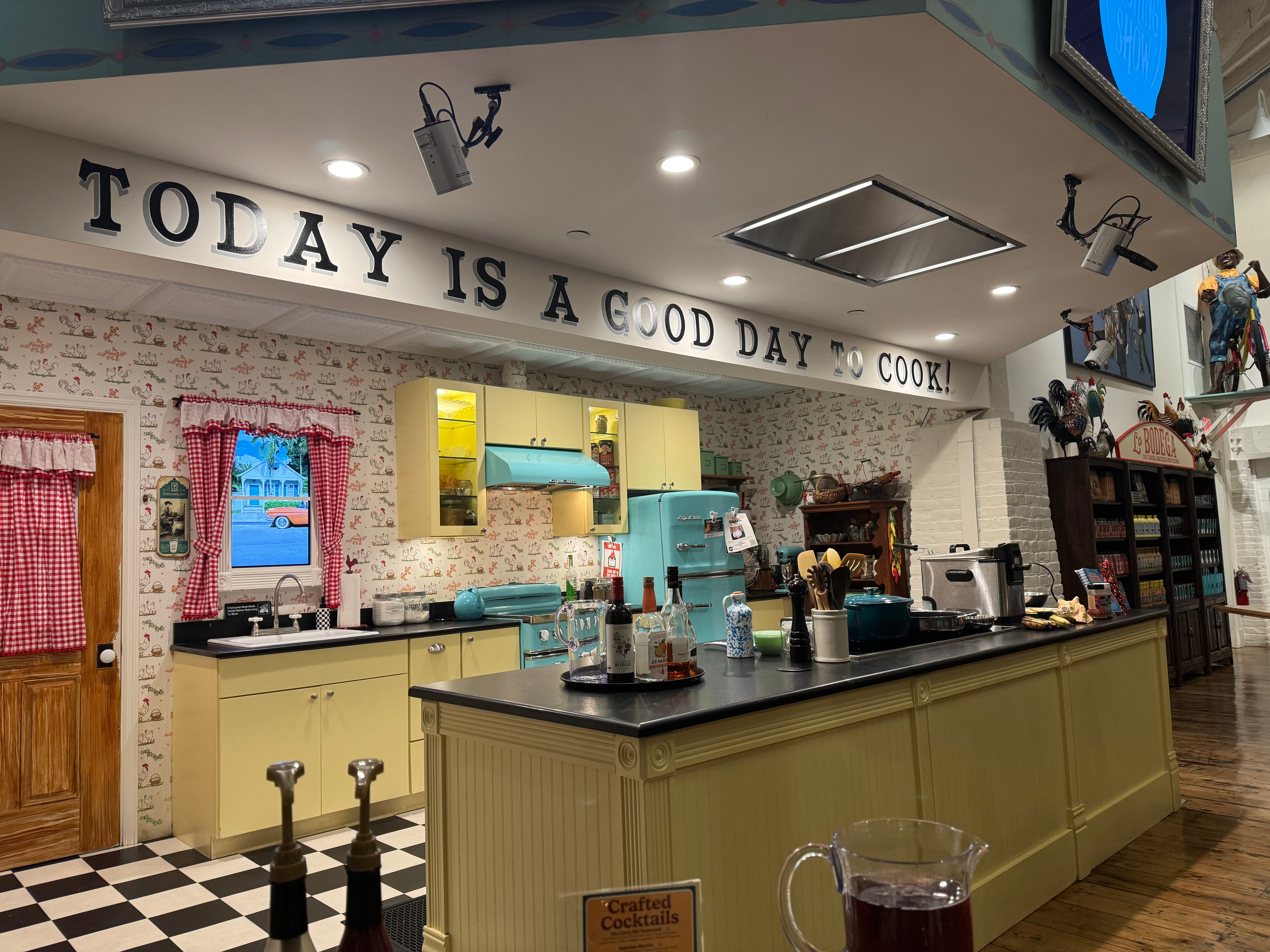
(The lovingly curated demonstration kitchen at The Key West Cooking Show)
A PARTING WORD:
The Caribbean topic would not be complete without offering kudos to the invention of one of mankind’s greatest food methods; barbecue!
It was only natural that the domestication of the chile peppers led to a marriage between them and pork. Both were born in the same heavenly place on Earth. The gifted cook know just how to use the ‘fire’ in the chilies to balance the fat and meat of great ‘cue.
The Caribs showed the first Spanish colonists how to smoke meat. It probably occurred on the island of Hispaniola. The Indian name for the green wood lattices the meat was smoked over was brabacot. The Spanish had trouble with that word and adapted it to the more familiar barbacoa. The meat of preference was pork from the wild hogs to be found roaming there. Their meat was tough but got tender through the ‘low and slow’ method they found worked best and continues in all great ‘pit’ style barbecue today. The meat, once smoked, was called boucan which is, interestingly, the root for the word buccaneer.
The differentiation between the Spanish-Caribbean method and the method now prized in regions of North America can be made clear when one sits down to “Lechón Asado” alongside “American Pit Barbecue”. The American methods have significant differences from region to region but it is usually made and served from separate cuts of the animal while the Spanish-Caribbean more often features the whole beast, (as varying levels of maturation). It would be unfair to have to choose one over the other! Lechón Asado is generally roasted outdoors over open fires or in a box often called a “Caja China”, (Chinese box). The pig is traditionally lavishly basted with mojo while it cooks. Some cooks have large syringe styled needles to inject into the meat a day or two before roasting occurs. Sides include plantains, beans and rice. Expect music!
Meanwhile in the U.S. the pit masters use cuts such as ribs, brisket, butts (a.k.a. shoulder), legs. It is imperative to use wood in making true barbecue. The topic creates debates that only religion, sports and politics have as equals! The major styles emanate and differentiate out of Memphis, The Carolinas, Kansas City and Texas. The dawning of America and barbecue go hand in hand. George Washington mentions attending a ‘barbicue’ in Alexandria, Virginia in 1769. It is possibly the most common technique created by both blacks and whites. And that is a good place to end...and start cooking… then eating!
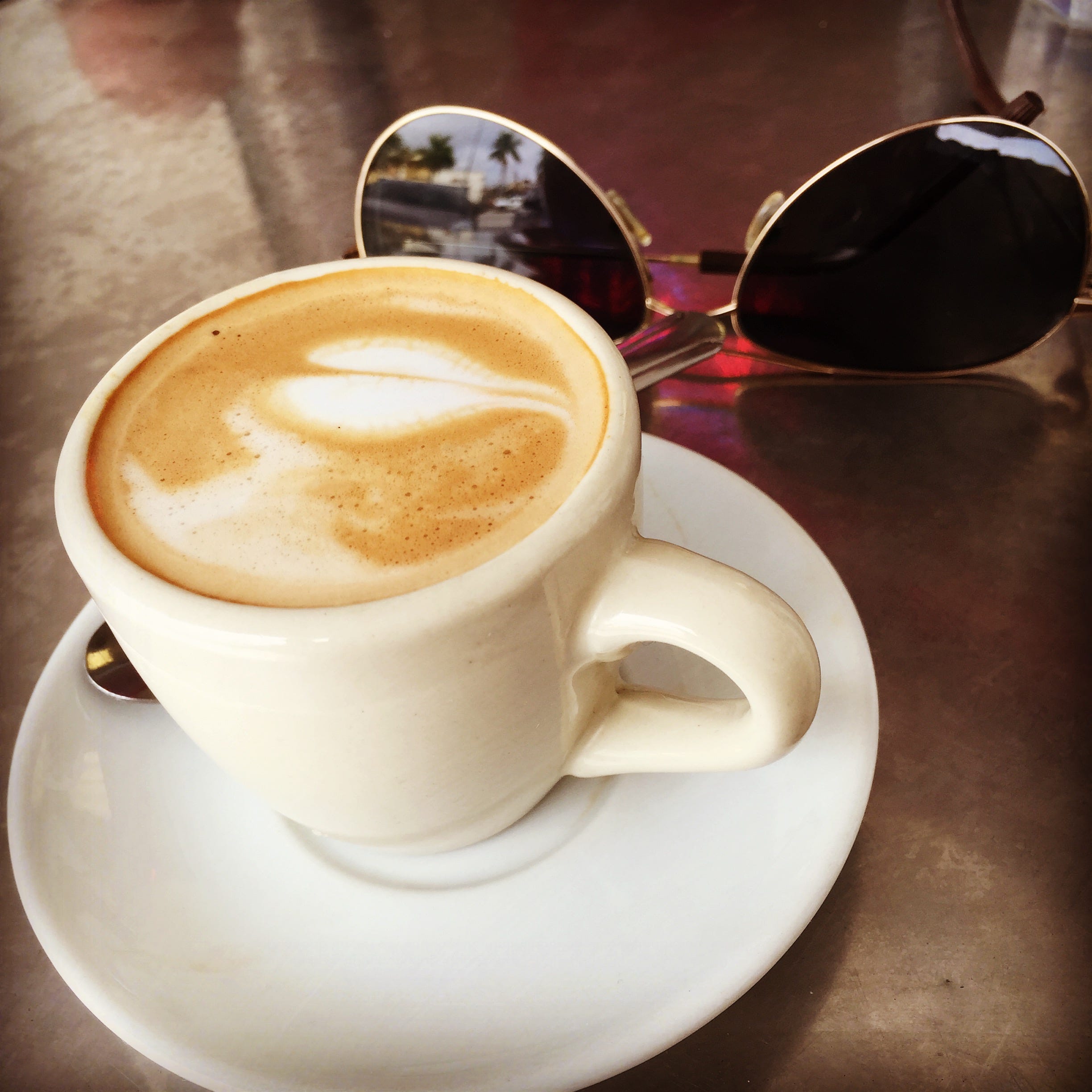
How I end most meals. A ‘Cortadito’…. often w a dish of Flan.
____________________________________________________________________
RECOMMENDED READING, A PARTIAL LIST ONLY
’The Complete Book of Caribbean Cookery’, Elizabeth Lambert Ortiz
‘Iron Pots & Wooden Spoons; Africa’s Gift to New World Cooking’, Jessica Harris
‘A Feast of Sunlight’, Norman Van Aken
“The Sugar Mill Caribbean Cookbook’, Jinx and Jefferson Morgan
‘Culinaria, The Caribbean’, Rosemary Parkinson
‘The Tropical Bar Book’, Charles Schumann, (Stewart, Tabori and Chang)
‘A Taste of Puerto Rico’, Yvonne Ortiz
‘Latin and Caribbean Grocery Stores Demystified’, Linda Bladholm
‘The Hot Sauce Cookbook’, Robb Walsh
‘Jerk from Jamaica’, Helen Willinsky
‘Sweet Hands: Island Cooking from Trinidad and Tobago’, Ramin Ganeshram, Jean-Paul Velotti and Molly O’Neill
‘The Cuban Table’, Ana Sofía Peláez
‘Braided Heritage’, Jessica B. Harris
‘A Feast of Sunlight’, Norman Van Aken