Birth Day
A Legend lives on.

‘SINCLAIR’S’ Restaurant
LAKE FOREST: 1982-84
Every day it was clearer to me that I was now the primary breadwinner for our baby boy growing up in the world now. When he shouted “Daddy!” I was the happiest I’d ever been. And we were, the three of us, so lucky. He was almost two! It was time for me to find my way to make it safe for him even though I still didn’t know quite how to do it. He looked at me with his big blue eyes as he tore through the world of discovery a child embarks upon whether Mom and Dad are ready or not. His Mom was ready. She was a natural. And he was additionally surrounded also not only by the supernatural love of his maternal grandmother but maternal great-grandmother as well. The prince of Diamond Lake! We read him “Mickey in the Night Kitchen” and he lived it!
I had been in my mother’s back yard during the majority of daylight hours for many weeks that spring. I was digging her a series of tiers to the back yard that cascaded down to Diamond Lake. She had transformed the same piece of earth where we had lived in what was “The Spanish House” to a beautiful, new wooden home with big glass windows and a fantastic porch but the yard was still a straight drop to the water that was both impossible to walk on and impossible to set a chair on without risking trundling down into the lapping waters of the lake. I had gotten big railroad ties delivered to the side of the property and I dug that stiff clay and mud with a spade in both an attempt to beautify her home but also to burn off the energy my body was used to draining in Key West kitchens.
I had put out my résumé around town, but no restaurant needed my help. So I dug. I positioned huge stereo speakers with wires that ran out of the house be closer to my work and “treated” the neighborhood to a lot of Lightening Hopkins and Muddy Waters. One afternoon Janet’s voice came cutting in over the din of my music and mudslinging.
“Norman! A man named Gordon Sinclair is on the phone!”
I remembered the name from a kind of promotional piece that we had come across and bought at a bookstore. It was a collection of Chicago’s restaurants current menus. There might have been fifty places in there with a picture of the restaurant chef or the owner. One of the restaurants in there was of a place downtown somewhere called “Gordon”, not “Gordon’s” like most folks refer to restaurants, but “Gordon”; like it was a person. I remember looking at the picture of the man the place was named for and getting the oddest feeling of connection. He wore a very unusual sport coat …‘natty’… might be the word for it. It had stripes. He looked like he could be on an album cover. Not the typical sober looking conservative dress for a Chicago businessman. And something in his face looked empathetic. When it was his name that Janet called out it was almost as if it was pre-ordained that I would hear it. Perhaps it was, because it changed the trajectory of my life.
When I got to the phone he asked, “Can you come to Lake Forest and meet me next week? We are almost done with our construction of “Sinclair’s” and I’d like to get your thoughts”.
“My thoughts?” I repeated to the now dead receiver, “My thoughts”? What did that mean? My ‘thoughts’ were that I better get a fucking job but quick cause, as the saw goes, “baby needs new shoes”.
I had no clothes for this interview. My Key West days had eliminated all but the most basic clothing needs. I was advised, very strongly, by my mother to go to “Langworthy’s” in Libertyville and buy a pair of slacks, a white shirt and at least a sweater if not a sport coat. “A sport coat?” I muttered. “Yeah, sure … maybe a ‘dickie’ to go with it all” I wasn’t so sure of all of this. But she knew I had to get a job too and she told me I could put the bill on her account until I got “back on my feet”.
When the day arrived to meet Gordon Sinclair, I drove to Lake Forest in my pickup truck. It was six years old and I’m sure most of the townsfolk of leafy, uber-rich Lake Forest took my dented red Chevy “C-10” to be driven by a person there to work on the estates.
Lake Forest is one of the most beautiful towns. Presbyterians established Lake Forest in 1857 and simultaneously created Lake Forest College. It was centrally located in the town’s identity offering a secure sense of cultural richness and high-minded pursuits. The wealthiest of Chicagoans built homes with names to go along with. There was “Walden” owned by H. McCormick Jr., “Westleigh” by Louis F. Swift of meatpacking fame and “Mellody Farm” by his partner, J. Ogden Armour.
It was a beautiful day with gusts of wind gently coming in off the mighty lake. To pass the time I walked around the perfect little town. I had been here before, God knows. The ‘Deerpath Inn’ where I had once worked was just off the town’s main square. I waited to meet the man that the restaurant was named for.
I passed by the tony shops of historic “Market Square” and looked down at my schoolboy threads and wondered if they’d be okay. Three men passed by me as a rush of wind rolled in. Was one of the men wearing a cape? I caught the side of his face as he shielded himself from the sweeping air and scattering of leaves. It was Gordon Sinclair! I was sure of it. He strode on. I decided that I should just go to the restaurant now and wait for him. I didn’t want to be late.
I drove the truck over to the corners of Forest and Westminster. My pickup joined those of the construction workers who were still installing the kitchen equipment, laying the terrazzo tile flooring and building the banquettes, bar and booths. The men ignored my V-neck sweater and me as I paced in the empty dining room.
Then I saw the sweep of that cape again and Gordon Sinclair walked in the dining room through an unfinished hole in the wall! It was startling! He had a black fedora hat and a finely checked suit, tan pointed shoes and driving gloves! He tore off one of the gloves and walked briskly over to me and extended his hand.
“Norman! How good of you to come! Let’s look at the blueprints!”
I was dizzy. How did he know who I was? He pulled off his cape and fedora and set them on a work table. Fred Astaire was the only man I had ever seen move like that. And it wasn’t in real life. Was this? It was happening very fast now.
He spread out the blueprints on a section of plywood that was stretched over two sawhorses. His silver cufflinks shone out of a baby blue silk shirt. His kerchief dallied out of his breast pocket. He showed me the dish table and the pot sink and their proximity to each other.
“I think on slower evenings one gentleman dishwasher could wash both the dishes and the pots, don’t you, Norman?”
After I squared the notion of a person being referred to in such a genteel way as a “gentleman dishwasher” in mind, I croaked something like, “Sure. But I am certain your Chef would have his opinion on that”.
He looked at me with the steadiest “Paul Newman blue eyes” (as he, himself would describe them later) and said, “I thought you were going to be my Chef.”
Maybe it was divine maternal intervention, but I found the moxie to say, “Yes, … sure Mr. Sinclair. I am!”
“Oh. Don’t call me ‘Mr. Sinclair’ he said looking at me with his warm, smiling face. It makes me feel old! He laughed. Call me Gordon”.
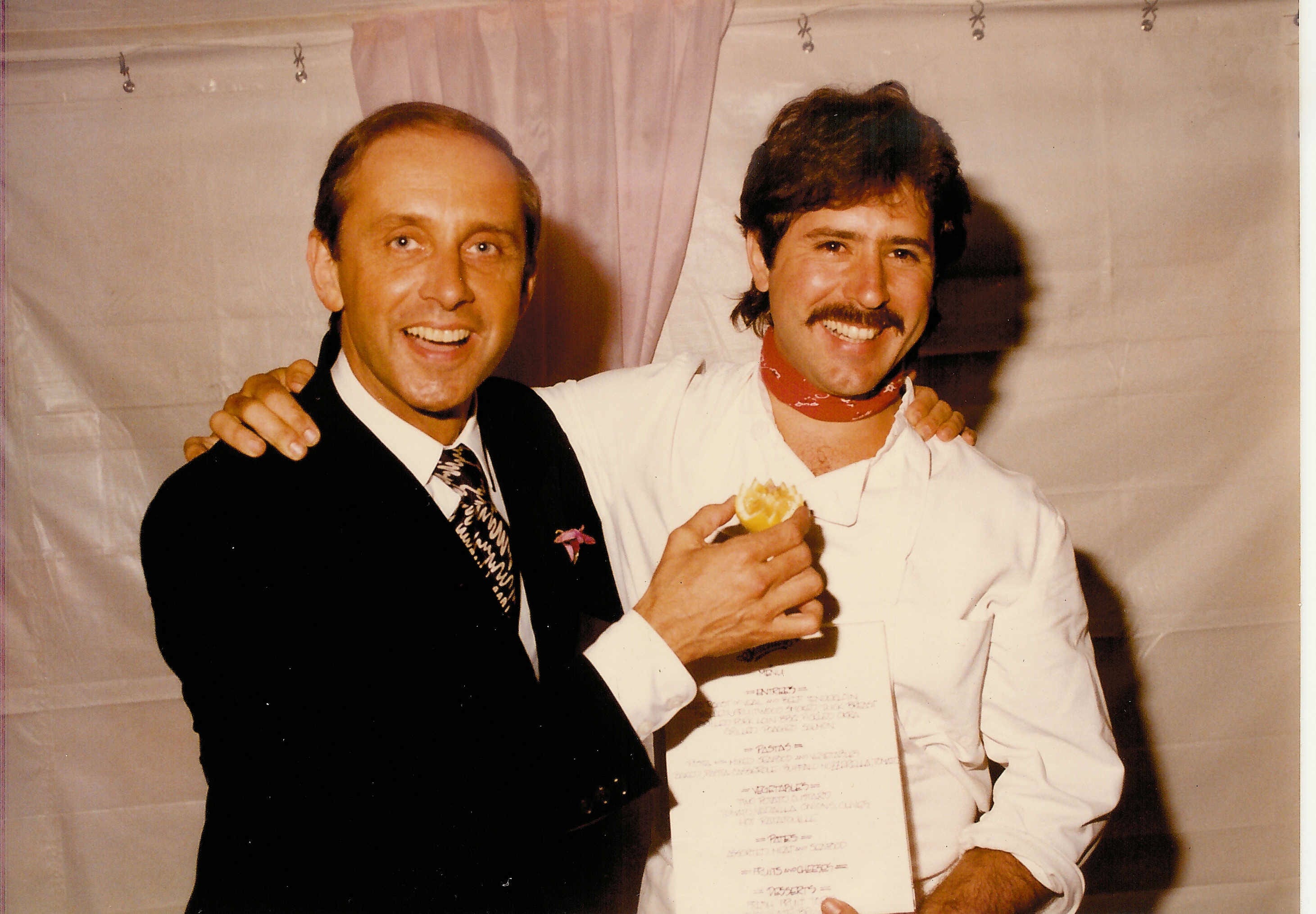
Since the restaurant was still under construction and there had been the typical delays Gordon explained that I would need to come to Chicago each day and help him plan the menu and get to know the purveyors and such. I couldn’t imagine driving my pickup to his elegant restaurant and parking it near the Cadillac’s and Lincoln’s each day. But then I heard the Lake Forest’s train’s whistle blowing as if on cue and I realized I could drive the truck to Libertyville, (just a stop or two the north and closer to my home) and ride to work each morning and back again each evening. I would be a commuter.
I had never lived in the city before and it was a new adventure and one that both scared and delighted me. I was such a small town person. The only city I had ever lived in was Honolulu and that was only for the six months I went to the University of Hawaii back in 1970-1971. Going into Chicago, Carl Sandburg’s “city with big shoulders” was a turn of events for me. And with the turning wheels of the railroad each morning there was also the turning thoughts that Gordon Sinclair propelled in me.
I arrived at Union Station each morning about ten. Thank God for restaurant hours in that even though I was there to work in his office he had to work each evening down in his restaurant “being Gordon” so he wouldn’t arrive until about eleven each day. Gordon treated me as if I were an equal in his project. I don’t know where he got this egalitarian ideology, but I was digging it. There were new books and menus each week that would be on his shelf and I was, he told me “free to peruse them”. Peruse them I did.
To my great fortune one of the books that was on that shelf in 1982 was “The Chez Panisse Menu Cookbook” by a woman named Alice Waters. I liked her face and her winsome smile on the book’s back jacket cover. She seemed to be inviting me to join her in a new American mission. I loved the book in many ways. One of them was her diary-like reminiscences of the nights of special menus and special events. It was a real confidence builder in that she admitted that even though they succeeded in accomplishing their ideas most of the time, there were nights at Chez Panisse when there was a fiasco in the kitchen and they had to deal with it. It was emboldening to me. Later I learned of Jeremiah Tower’s seminal contributions to Chez Panisse. A book I’d read back in Key West, the “Auberge of the Flowering Hearth” sensibility seemed more fully in place there than any restaurant I had ever heard about in America! The book was part cookbook and part manifesto. It called for intelligence and connectivity to nature in ways intimated in the works of Elizabeth David and James Beard but in a soft, imploring voice. Ms. Waters conveyed a both a sense of perfection and a striving for an ideal in a way that signaled the utopian ideals I was always searching for.
Gordon showed me other ideas from his travels that excited me too. He brought back a menu from a new place called “Spago” in Los Angeles. The chef was the theatrically named “Wolfgang Puck”. The “chef drawings” replicated on the menu’s cover were very much like ones that I was making for my cooks to show them how I suggested I wanted something plated. Maybe I was on to something! Maybe there was a kindred spirit afoot here. The transplanted Austrian, now Californian chef’s food bespoke of a real pride in American regional ingredients. I suddenly wanted and needed to find “Maui Onions” and “Santa Barbara Spot Prawns”! His food also embraced the Asian aesthetics and my memories of my former Japanese chef, Toké at “The Deerpath Inn” came rushing back to me with a power of what I could do to show homage to him in this beckoning new sense of America’s cuisine. I wanted to make a “Sizzling Catfish” and serve it with Dandelion Greens! Gordon raved about the simplicity of Spago’s décor, of how it was so inviting rather than intimidating. Gordon was the most modern of restaurateurs. Had he opened his original “Gordon” restaurant in New York versus Chicago I’m certain he would have been as famous and lionized as Sirio Maccioni if perhaps with a more cutting-edge crowd. His skewered sense of humor and droll wit were just the antidote to too much passion. Gordon was being interviewed by a reporter for The Chicago Sun-Times one day in the dining room and when the journalist asked for a definition of this “New American Cuisine” I waited alongside the newspaper man with real anticipation … waiting for this eloquent and dapper man to give the defining answer if not an all-out apocalyptic one said with his nasal Michigan accent. “Oh, I guess it is that now we put the sauce under the meat and fish instead of over it”. But that was just Gordon making sure that the media’s klieg lights were not only focused on the food but on the whole grand spectacle of it; and the whole grand yet sweet act that was “Gordon Sinclair”. I once asked Gordon what he thought I should shoot for when plating a dish. He had complained that the way I had done one was just too formal. I said, “can you give me an example?” He pulled on the lapels of his double-breasted jacket and stared down at my plate. Then he looked up and said, “It should be familiar and timeless … like The Mona Lisa … but I want her to have a little strand of spaghetti peeking out just a little from her lips”.
In Sept of 1982 the restaurant opened. I soon found myself each day thanking God that I had the good luck to hire a young woman named Carrie Nahabedian. You see I hadn’t the skills to really be in this position. What I apparently had was the right astrological chart! I didn’t know it at the time, but Gordon had a chart done on each of his prospective chefs. I had been given a glowing letter of reference by my former Key West employer David Wolkowsky from The Pier House. But what shooed me in was the divination of the stars. Those stars weren’t there to illuminate me and I was suddenly in a kitchen putting out food that would be compared to and held up to the rigors of a much more sophisticated audience than I had ever known in Key West, Florida. Part of it was Gordon’s reputation but one of the other significant factors was due to the fact that Sinclair’s in Lake Forest was not really owned by Gordon Sinclair but by local resident and near billionaire, Marshall Field IV. “Marshall” as Gordon called him and “Jamee” as he called Marshall’s unaffected and attractive wife would bring all of the blue bloods of North Shore society and thus the aristocrats and descendants of 18th and 19 century American capitalistic dynasties to our restaurant. They would sup with us or with the likes of Chef Jean Banchet who cooked in nearby Wheeling at his restaurant “Le Français”. Banchet was a protégé of the legendary chef Fernand Point of “La Pyramide” fame and considered by many to be operating the finest restaurant in America. “Bon Appetit” magazine put him on their cover suggesting if not outright saying so. Point was the original “Pope” of cuisine, and his book “Ma Gastronomie” would become a kind of chef’s life bible for many chefs. To be sharing a venue in such proximity to Banchet’s knowing that guests would be coming to us after dining under the great Frenchman’s was a task so large and beyond my abilities I nearly shivered at the prospect of the learning curve I was on. But fortunately for me the younger and much more experienced in these altitudes Carrie was with me. Also, fortunately I was still too naïve to really grasp the breadth of the chasm between my skills and Banchet’s.
Carrie had worked at “Le Français”. One night a few months later she even took me over there to borrow some fish after we had a particularly heavy night. I got to tour the walk-ins and saw the game hanging and aging in his coolers. I even snatched a wild morel mushroom as we were leaving and stuffed it in my pocket. I had only read about them and never tasted one. When Carrie asked me what I was eating as we pulled out of the gravel driveway, I told her. She pulled the honeycombed textured mushroom directly out of my mouth and hurled it out her driver’s side window and scolded “You have to wash them to get rid of any mites and cook them first or they can make you sick as a dog!”
She has also worked for one of Chicago’s very greatest restaurateurs Jovan Trboyevich of “Les Nomades” and one of Chicagoland’s most beloved Leslie Reis of “Café Provençale” fame. Word had it that she was the very first female chef that Banchet hired. She had some scars to show for it. I soon realized that she could dish it out too. Carrie was born to be a chef. As much as any person male or female she was born to be the kind of chef that one thought of as a true ball busting but sick with talent chef a French Chef was supposed to be. She got it. She understood it. She reveled in it. She had cream and butter in her DNA. She also knew how to see talent in young cooks and how to either coax or kick it out of them. She was a strong-shouldered raven-haired, dark-eyed woman of good Serbian stock.
She knew she should have been Exec Chef, I’m sure. But she was dealing with the old realities and sexism that was still entrenched in the system and stood by my side as I raced to learn some of the techniques and products that I had never seen before. She was my second in command, but I would have been buried in the rich soil of Lake Forest if she hadn’t come to join me that summer.
We had a good team, but we were charting new waters. I loved Carrie’s strengths with the classics, but she sensed we needed to find a way to express this blossoming interest in American flavors and foodstuffs too. She was a bit bored with the old canon of dishes. I think that is another reason she signed on with me.
One day a young man applied to work with us that would have much to contribute to this field, but for now he was just a young man, with no experience, looking for a job. He was a boy of what I would have guessed to be 18 years of age … perhaps from Lake Forest High School. He entered the kitchen. I had just arrived to work and had not changed into my “whites”. His skin was soft, and pale and his hair hung unevenly across his forehead. He asked one of the dishwashers to see the dining room manager. The man he asked spoke little English, so I told him if “it is for a front of the house position the manager was not here yet”.
He said, “Oh … You work here? I thought you were a delivery guy.”
It was then that I noticed the startling quality of his eyes. They illuminated his face as two freshly cut gems might illuminate a cave if met with a single shaft of the right light.
“Yes. I am the chef. What’s your name?” I asked.
Something seemed to startle him.
“Chuck” he said. But then he bolted out the door.
A few nights later I recognized him at our pre-service meeting with the dining room staff where I went over the nightly specials. He was in busboy uniform. I gathered he’d gotten the job.
Over the course of the next few weeks I may have had an occasional word with him. “Run this soup”…“Clear this dirty plate” etc. But no dialog.
Then a month or so later he came into the kitchen around 2 p.m. … well ahead of when the floor staff was required to be punching in. He came up to me and haltingly asked me for “a job … any job …in the kitchen”. I informed him that we were currently “all staffed up”. He left without a word.
“Did he almost bow or something when I told him I wasn’t hiring him?” I asked Carrie afterwards. She kind of screwed up her face in the look of annoyance she got when something bothered her or didn’t add up. “Don’t know” was all she said and continued to chop up lobster bodies for the bisque she was making.
The young man came back the very next afternoon and I gave him the very same answer.
This continued for the next week.
Finally, Carrie came over to me after the sixth or seventh rebuke and said, “Let’s give him a shot. He really wants to work in the kitchen.” I said, “Where do you think that skinny little guy could work, Carrie? He looks like the Lake Michigan wind could carry him out the door.”
She said, “Let’s put him in garde manger and see if he can handle it. If he can’t, he’s gone, but I think I see something in this one”.
So, the young former busboy started to work in our kitchen. I asked him his name again the day Carrie brought him up the stairs in a cook’s shirt and apron. He said, “Chuck”. Then he added, “Well actually my name is Charlie Trotter, but everyone calls me Chuck”.
“All right Chuck”, I said, “Let’s see if you are cut out for this side of the restaurant world. Let’s see what you got”.
~~~
Today would be Charlie’s birthday. A day to celebrate always.
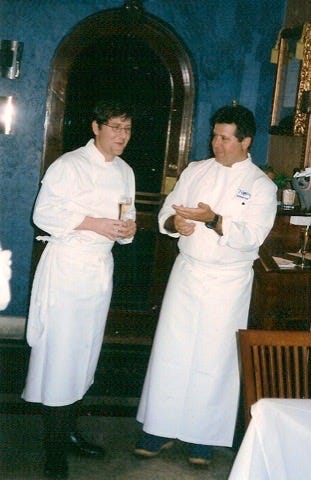
~This is partially excerpted from my memoir, “No Experience Necessary, the Culinary Odyssey of Norman Van Aken”. (Taylor Trade Books). Audiobook as well.